Nothing Fancy by Diana Kennedy
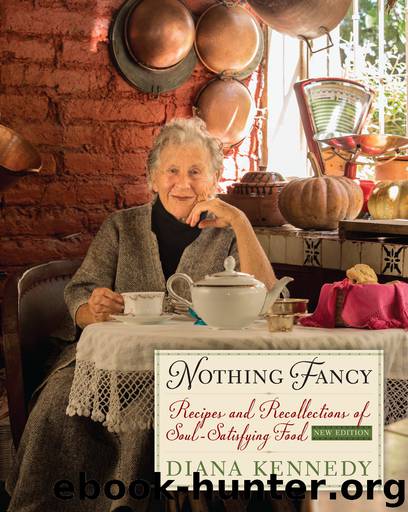
Author:Diana Kennedy [Kennedy, Diana]
Language: eng
Format: epub
Publisher: University of Texas Press
Published: 1984-12-09T16:00:00+00:00
Yeast Breads
No supermarket manager need ever worry that he will catch me squeezing the Charmin—I’ll be over in the bread section squeezing away in wonder that so many soft, spongy, sweetish loaves are made and consumed in the name of bread as though teeth had gone out of style.
There have been a plethora of books and articles on the subject of bread making, which in many ways is great—but so many have encouraged this “bouncy” sweet loaf (one notable exception being Julia Child’s meticulous instructions for making a good French loaf). Let’s get back to basics and learn to chew again.
I was brought up with lots of yeast breads, many of them doughy, but at least they had a good crust and were made of whole wheat flour. I remember, too, crusty, almost hollow Viennese rolls, reminiscent of the large, extraordinarily crisp “Hops” bread rolls that used to be made in Trinidad years ago. French, Italian, and Russian peasant breads are unrivaled, and in some parts of Mexico that also holds true—but too many bakers have gotten the message that sugar not only works the yeast faster but helps produce a more appetizing-looking crust.
In Mexico, whole wheat bread is considered unpalatable and unacceptable. Fortunately, there is a wheat mill on the edge of town. Don Alfredo Domínguez, one of the owners, always expresses regret that his machinery doesn’t produce real whole wheat flour, but he does go and hold paper bags—or lets me do so—under the tubes that eject the different parts of the grain.
I always refrigerate the most perishable parts (the germ, semolina, and bran) and then mix flour to suit my fancy: today a little more wheat germ, for my pasta some of the semolina that is quite textured, or a choice of two brans.
Bread making is fun if you are not tied to one recipe or flavor. If you don’t feel like heavy rye or 100 percent whole wheat, then add some high-gluten flour or sprouted grains to give the bread texture and make it more interesting. In the last century, potato was often mixed with the flour in bread making, probably as an economy; certainly a little mashed potato in rye bread or muffins, for instance, does help work the yeast, but it also gives the bread another slight dimension of taste and moisture.
I hope that some of the following recipes will inspire you to try something different.
NOTE
Always dry the flour for yeast baking, in the sun or in a slow oven, and use while still slightly warm.
All water measurements are approximate because one may need more, depending on the weather and the type of flour.
NOTE
High-gluten flour is already prepared principally for baking bread. Gluten flour (for example, as put out by El Molino) is a gluten concentrate. As a rule of thumb, 1/4 cup (65 mL) of every pound of ordinary flour used should be replaced by 1/4 cup (65 mL) gluten flour.
Crumpets
11 crumpets
I can still hear to this day the clang of the muffin
Download
This site does not store any files on its server. We only index and link to content provided by other sites. Please contact the content providers to delete copyright contents if any and email us, we'll remove relevant links or contents immediately.
Biscuits: A Savor the South Cookbook by Belinda Ellis(4346)
The French Women Don't Get Fat Cookbook by Mireille Guiliano(3671)
A Jewish Baker's Pastry Secrets: Recipes from a New York Baking Legend for Strudel, Stollen, Danishes, Puff Pastry, and More by George Greenstein(3611)
Ottolenghi Simple by Yotam Ottolenghi(3601)
Better Homes and Gardens New Cookbook by Better Homes & Gardens(3599)
Al Roker's Hassle-Free Holiday Cookbook by Al Roker(3536)
Trullo by Tim Siadatan(3435)
Bake with Anna Olson by Anna Olson(3410)
Hot Thai Kitchen by Pailin Chongchitnant(3399)
Panini by Carlo Middione(3347)
Nigella Bites (Nigella Collection) by Nigella Lawson(3243)
Momofuku by David Chang(3197)
Salt, Fat, Acid, Heat: Mastering the Elements of Good Cooking by Nosrat Samin(3157)
Modern French Pastry: Innovative Techniques, Tools and Design by Cheryl Wakerhauser(3149)
Classic by Mary Berry(3020)
Best of Jane Grigson by Jane Grigson(3008)
Tapas Revolution by Omar Allibhoy(2991)
Solo Food by Janneke Vreugdenhil(2982)
Ottolenghi - The Cookbook by Yotam Ottolenghi(2954)
